The Firmament Friends Take Flight I: Lost in the Southern Sky
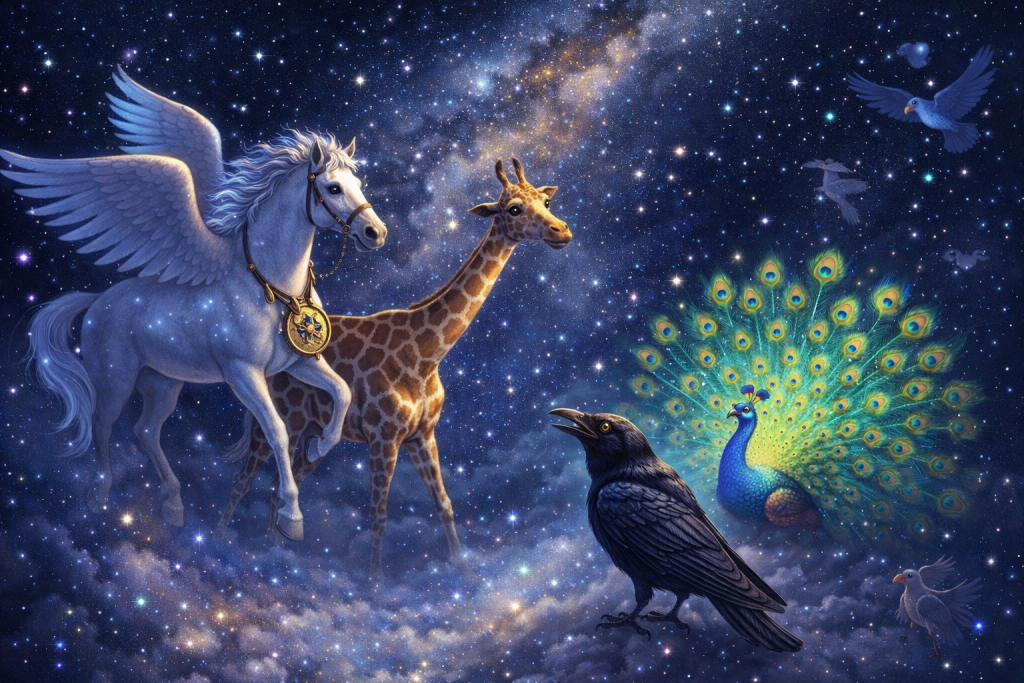
In the night sky–also known as the Firmament–high, high above the Earth, thousands of stars twinkle. Some are very bright and some almost dim; some are closely clustered and some spread out. These clusters have come to be known as constellations, and among them are Pegasus, the winged horse, and Camelopardalis, the giraffe.
Pegasus and Camelopardalis were the best of friends. One night, they were grazing in the vast plains of the northern firmament. Camelopardalis’s long giraffe neck allowed him to forage high in the sky, and Pegasus’s wings allowed him to swoop up, and then down, as he tugged at tufts of celestial grass. The two friends bobbed in the broad darkness, illuminated by the thousand stars surrounding them and by their own brightness.
They played tag. They shouted with delight. And, little by little, they began to move away from their own neighborhood in the sky. Little by little, they moved away from their constellation friends and toward the fog of the Milky Way, which arched across the sky like a wide road.
They knew better than to go into the Milky Way. They had overheard Ursa Major, the great bear, warn her son, Ursa Minor, the little bear, many, many times never, ever to wander into the Milky Way. Pegasus and Camelopardalis had become good neighbors with the bears while the bears, in motion with them, lumbered along their circular path in the Northern sky. Ursa Major had a special fondness for Pegasus and Camelopardalis and had taught them many of life’s lessons at the same time she instructed her son. Ursa Major was very observant and had seen a lot of life from her Northern stellar den.
But on this night, Pegasus and Camelopardalis forgot Ursa Major’s warning about straying too far from home, and moved closer and closer to the cloudy mist of the Milky Way. First they wandered just a little, but finally a lot—and, oh my, did they wander quite a lot! They romped and romped, playing hard, and not paying attention. Soon they were deep in the Milky Way’s white fog.
The fog disoriented them. They couldn’t see the Pole Star on the tail of their young friend Ursa Minor. They couldn’t see shiny Cassiopeia, Andromeda, or Perseus, their closest constellation neighbors. They couldn’t see the Gemini twins, Castor and Pollux, whose bright stars had served as lampposts to guide the way back when they had previously moved away from their usual positions in the sky. Now, they were disoriented and couldn’t make out any neighborhood landmarks. To make matters worse, they had left behind the astrolabe that Pegasus had won as a prize at school for studying hard and which he usually wore proudly on his bridle. Now, they couldn’t find their way home!
They started to grow fearful, knowing that the sunlight of the coming morning would start to shine and block out any hope of their seeing the faces and forms of their constellation friends. But morning dawned.
Camelopardalis held back his tears. Pegasus, ever resourceful, developed a plan: hold tight, remain stationary, and wait until it would be dark again to find their way.
They waited and waited. Because Camelopardalis was afraid, Pegasus tried to keep him cheerful by telling him stories. He told him the story about Lyra, the gentle harp from back home whose music could be heard throughout the Northern summer sky and even, sometimes, fall mysteriously upon the ears of those on earth, although barely in a whisper. Each year, in the late summer, Lyra’s beautiful and sad music announced the coming winter. The bright blue star Vega adorned the harp like a shining jewel.
Pegasus told Camelopardalis how Cygnus the swan traveled the sky with Lyra. “When Cygnus says goodbye to the warm weather,” explained Pegasus, “she follows Lyra.”
Camelopardalis wanted night to return so he could go back to Cygnus and Lyra. He didn’t want to be lost in the Milky Way with Pegasus, and he didn’t want to hear any more stories. He wanted to be close to home with the bears. He was sorry he hadn’t listened to the mother bear Ursa Major’s warning. Now, he wondered if he and Pegasus would ever make it back. He was sorry, too, that Ursa Major wasn’t with them. Ursa would know which way was north.
Slowly, slowly, the sky started to grow deep black again as night followed day. The two friends peered through the milky mist, straining to identify friends and neighbors. One tiny light, and then another, became clearer and brighter. Each tiny light began to twinkle, and each twinkling light merged into a cluster of lights, slowly growing into many constellations. They peered intensely. Pegasus, who knew the sky well from swooping up and down, didn’t recognize any constellations nearby. Eventually, there were thousands of stars in their midst, but none was a friend.
He was puzzled. He didn’t want to alarm poor, fearful Camelopardalis, but they needed help in navigating their way back to the North. Oh, how he wished he had his astrolabe!
Camelopardalis was tired. He wanted to go home where he could rest his long neck on the stars of the tail of Ursa Minor, which he liked to do, and take a nap.
Pegasus squinted, his eyes still looking for a familiar landmark. He listened intently for familiar voices from back home.
Then, out of the mist, close up, he noticed with surprise an iridescent shadow, oval shaped, and shimmering. He watched the shadow, wondering what it was. The oval took on an enormous fan shape, filling a portion of the now dark sky. The fan shape was connected to two thin legs, like the legs of Cygnus. In front of the fan, there rose a small head which was no more than a tiny ball connected to a very long neck. But the head, the neck, and the feet were hardly noticeable next to the extraordinary and very beautiful tail. What Pegasus was seeing for the first time in his life was a peacock—a peacock in full fan-tail display.
Camelopardalis jumped back. He closed his eyes, afraid of the fan. He wanted to run back into the Milky Way and hide.
Pegasus consoled him, “No, no, don’t run away, Camelopardalis! This is a bird like Cygnus. Look at his feet. Look at his head. They are the same as the swan’s.”
Curious Pegasus wanted to study this bird and talk to this bird. This was a new kind of constellation from the Southern sky. He pranced around the peacock, and said in a friendly way, “Ahoy, there! My name is Pegasus. I’m a winged horse constellation from faraway.”
The peacock looked down his pointed face at the horse, but didn’t answer.
Pegasus tried again. “Hey, you! I come from the Northern Hemisphere, and I’m trying to get back. Have you seen my friends Ursa Major and Ursa Minor? Have you seen Cygnus? I’m sure they are looking for me by now. Hey, you look kind of like Cygnus yourself, except for that big tail you have.”
Pavo the peacock stretched out his beautiful tail even bigger.
“We are trying to get home,” continued Pegasus. “This is Camelopardalis. He’s a giraffe.”
Pavo stepped back. He didn’t know who these visitors were. He had never seen a winged horse or a giraffe. He strutted a few steps forward, his tail still fanned, trying to get a better look at them. Pavo was not talkative by nature, but now he was truly at a loss for words.
Pegasus, however, was eager to carry on a conversation. “What kind of constellation are you?” he asked. “Where do you live? Why haven’t we seen you before? Do you have any friends? Do you know how we can get home?”
Pavo paused a few more moments, but then he finally motioned into the dark with his beak. He mumbled slowly and in a very low voice, “Corvus. Corvus knows.”
Pegasus didn’t know what a Corvus was. He figured the Corvus lived near and would have the answers to his questions. He wondered if Corvus was another bird, or maybe a horse, or even a serpent.
Pavo strutted off, his tail shimmering magnificently in the moonlight as he moved. Pegasus watched him go. Would he return with Corvus? And what would Corvus be?
Pegasus and Camelopardalis waited again. They waited and waited, and were ready to give up hope on Pavo’s return. The only thing they could really identify in this Southern sky was the moon. The moon intrigued all the constellations: most could not figure out her mood or her movement. It seemed she came and went in and out of the firmament as she pleased, becoming bigger, then smaller, then bigger, then smaller month after month. There were many legends about how she cast her shadow upon the Earth, how she commanded the ocean tides, but no one knew anything for sure.
By this time, Camelopardalis was crying for real. Pegasus didn’t know how to comfort him. From the great beyond of the immense sky, they could just make out the screeching call of Pavo, “Eear, eear, eear,” calling out for Corvus. Although the Northern visitors didn’t know it, Pavo was determined to find Corvus and bring him back to Pegasus and Camelopardalis, to help the two lost constellations find their way home.
Some time later—it seemed like forever to Pegasus and Camelopardalis because they were so frightened—Pavo returned. With him was his friend Corvus.
Pegasus and Camelopardalis beheld not a horse, not a serpent, but a shiny black bird. Corvus was a crow—a constellation of only a few dim stars, but of acclaimed status and respect in Southern sky society. Corvus had all the answers. He was very clever. He knew the names of all the constellations, kept track of the calendar, and could solve any problem. His place in the firmament, bridging almost both hemispheres, allowed him to keep an eye on happenings in the South and happenings in the North. Nothing was too much for Corvus’s abilities and wisdom.
Corvus took one look at the winged horse and giraffe and had a ready remark. In a gruff voice, he said, “I can see you fellows are not from the south. How did you get here? You must be from the Northern Hemisphere. This kind of mix-up is very rare. You were playing near the Milky Way, weren’t you? Not a good plan, not a good plan. Now you are lost, and everybody is upset. Pavo is running around screeching ‘Eear, eear, eear,’ dragging others out of their nests to come and see you. Now what do you expect us to do?”
Pegasus felt very uneasy as he watched the big crow move his flat head from one side to the other, using one eye at a time as he looked them over. The crow’s beak was long and sharp, and his claws were curled into balls, ready to grasp anything—maybe even ready to grasp Pegasus’s neck. If Pegasus was afraid of Corvus, how could he ask him for help? Corvus seemed to be making it clear that he was annoyed at being roused from his roost and summoned by the peacock to evaluate the situation.
“Excuse me, Mr. Crow,” said poor Pegasus. “I am wondering if you could help us determine where we are, and how we can return home. My friend Camelopardalis and I want to go back to our home, and to our friends who are probably missing us by now. We live by Andromeda and Cassiopeia, the queens of the North.”
Camelopardalis had started crying again. Now, his long neck was folded downward, his head hanging like a lantern on a pole, as he dabbed at his tears as best he could with his hooves. His thick giraffe eyelashes held back some of his big teardrops, but most ran free, stretching into river-like stripes down his face. He sniffled and sobbed, unable to control himself, and just wanting to be back with Ursa Major and Ursa Minor in his Northern home.
Pegasus put his own fear aside to comfort Camelopardalis. He lifted the giraffe’s fallen head with the top of his own neck, flying in like a bulldozer to push it back into an upright position. He swooped around Camelopardalis’s head once it was at the top of his long body again, trying get a smile out of him. “Come on, Camelopardalis” he encouraged his friend, “everything’s going to be OK. Corvus is here to help us.”
When Corvus saw how kind Pegasus was to his frightened friend, he, too, warmed up, casting aside his gruff demeanor. Camelopardalis and Pegasus were just youngsters, far from home, and among constellations of strange shapes they had never seen before. Corvus relaxed his curved claws, lifted his beak in the air, and mimicked the voice of Pegasus, “Come on, everything’s going to be OK.”
Camelopardalis and Pegasus were startled to hear what sounded exactly like Pegasus’s voice coming from the crow. They became distracted from their despair, and intrigued by Corvus’s special skill. Showing off to please the visitors, Corvus repeated, “Come on, everything’s going to be OK,” followed by “’Eear, eear, eear,’ everything’s going to be OK. Corvus is here to help!”
“’Eear, eear, eear,’ have no fear,” they sang. Pavo joined in for the “eear, eear, eear” refrain, opening and closing his shimmering tail to the beat. Pegasus and Camelopardalis hummed along, clicking their hooves every time they heard “eear, eear, eear.” Pegasus swooped high and low, as Corvus led them all in chorus in an attempt to keep Camelopardalis’s spirits high. “’Eear, eear, eear, have no fear!” they sang together, and “‘Eear, Eear, Eear’ Have No Fear” became their happy song from that moment onward.
The joyous caroling carried far and wide, drawing the attention of others. In flew two more constellations, Toucana, the high-spirited toucan, and Columba, the gentle dove. Toucana joined in the singing, without any understanding of what was going on, his dry voice sounding somewhat like the croak of a frog. “Creek, creek, creek,” he sang with all his might. Columba also joined in, singing, “Coo, coo, coo,” in a low, steady pitch.
Camelopardalis even took some shaky tip-toe steps with this lanky legs in an attempt to dance. He had come to realize he had new friends now who cared about him and wanted to support him through his troubles. With his odd giraffe snout, he nuzzled the birds in a sign of friendship. In turn, the birds were unafraid of his large size and extraordinary shape.
There was no good moment for Pegasus and Camelopardalis to introduce themselves to the newcomer birds without risking an interruption to the happy singing. Toucana, noted Pegasus and Camelopardalis, had an enormous bright orange and green beak. They had never seen such a bedazzling beak ever. Toucana had tiny eyes like black buttons. His throat was bright yellow, and looked like a collared shirt peeking through a fancy black jacket. He had a bold personality, and, like Corvus, liked to keep an eye on the goings-on of the Southern Hemisphere.
By contrast, Columba was shy. She was a soft gray color and her only decoration was a dark-colored half-ring around the back of her neck. She wore both her plumage and her personality with modesty. Her voice was soothing, and her overall presence was gentle and kind. Camelopardalis and Pegasus took an instant liking to her.
When the singing died down, Corvus cleared his throat, “Uhh, uhh,” and made the following pronouncement: “Gather thee now, esteemed Southern friends, to consider the plight of these two constellations from afar.”
In calling the meeting to order, Corvus arranged the three other birds in a semi-circle, with Pegasus and Camelopardalis in the middle of the group. Corvus spoke using unusual ancient words which he had picked up long ago and now mimicked. His language was very hard to understand, and, truly, the others were puzzled by most of what he said, but they nodded in agreement anyway. They were all anxious to make things better for Camelopardalis and Pegasus, and didn’t want to lose any time by asking questions or asking for modern interpretations of the ancient words.
“We are here today to solve the problem of Pegasus and Camelopardalis. They long to return to the Northern Hemisphere. They do not know their way back from here. It is our duty to come to the aid of fellow constellations and to develop a plan for their return home.”
Or, at least that is what the flock knew he wanted to say. What he actually said, mistakenly mimicking words he had heard long ago, was something completely different.
Corvus recited somberly, in grave oration, the following:
“You have to know the time to know your nose.
Merci beaucoup. Merci beaucoup.
The safari, so far, has gone so far that you might miss the start of the show.
And don’t forget to take your umbrella in the event of falling triangles.”
The constellation flock cheered his pronouncement, although none of it made any sense to them. As they listened, they bobbed their heads up and down, but when he started in about picking your nose, and when he got to the part about the triangles, they stopped, their heads frozen in midair, as they were overcome by bewilderment. They were united in helping the travelers, nevertheless, and so carried on with Corvus’s show. Corvus, noting puzzled looks from his audience, eventually let go of his rusty, ancient language and reverted to common speech, although he interspersed it with “Caw, caw, caw!” when he wanted to make an important point.
Toucana interrupted the proceedings to make known that there was still one constellation missing from among the assembled flock. “Creek, creek! Wait, wait!” he shouted. He flew off to get Grus the lanky crane who was his neighbor. Toucana knew where to find Grus, because Grus could always be found by Fomalhaut, the chief star of Piscis Austranis, the fish constellation. Grus waited night after night, hoping to catch that fish in his beak.
The crane, once installed among the assembled birds, did not say a word to anyone. He apparently had to focus on maintaining his balance, which was difficult because he was made up of nothing more than thin bars: two very long and thin legs, a long and thin neck, and a long and thin beak. Camelopardalis observed Grus carefully, wondering if a giraffe like himself could stand upright with two, not four legs. Camelopardalis also had to manage long legs, a long body, and an especially long neck. He wanted to make friends with Grus and ask him some questions, but this didn’t seem to be the appropriate time.
“Toucana and Columba had once spoken of wanting to travel to the north side of the firmament, but we discouraged them,” continued Corvus. “Crossing between the hemispheres is serious business and not to be done without serious planning. Caw, caw, caw!”
“And don’t pick your nose either!” shouted Camelopardalis, still in high spirits from Corvus’s earlier nonsensical monologue. In surprise, the other constellations glared at Camelopardalis, but then quickly resumed listening to Corvus.
“Look what happened to Pegasus and Camelopardalis!” continued the crow. “With no planning and no destination, they have become celestial vagabonds! The North is still uncharted for those of us living in the South, just as the South is unfamiliar to those from the North. To get to the Northern Hemisphere,” concluded Corvus, “we know there is a skyway path between Scorpio, the scorpion, and Centaurus, who is half-man and half-horse, but the journey is not an easy one. Caw, caw, caw!”
“To pass by Scorpio is dangerous, that’s for sure,” joined in Toucana. “Scorpio is an enemy to all and will attack if you venture onto his territory. Beware. The scorpion has a very nasty sting.”
“As for Centaurus,” added Columba, wanting to be helpful but blushing from shyness, “we know he likes to be left alone, too, so you can’t make any noise. By the way, Pegasus, Centaurus looks a little like you. He has your legs and hooves, your long tail, but no wings. But, of course, he has a human chest and face.”
Pegasus and Camelopardalis listened with rapt attention. They were appreciative of Corvus’s ability to plan, even if they had been jarred by his earlier erroneous warnings of falling triangles and other nonsense. Obviously, Corvus didn’t want any harm to come to them as they made their way back to the North.
Meanwhile, Toucana and Columba, who had been conferring between themselves, erupted with their signature creeking and cooing as they suggested a strategy to the group. Toucana spoke for both of them, “Creek, creek! I have always wanted to go to the North. Maybe I could accompany our visitors home. And Columba wants to go, too.”
Columba rocked back and forth, pushing out her chest to indicate her agreement, and cooing softly. The other constellations reacted with surprise.
Corvus appeared annoyed, “You don’t know what you’re saying. You don’t understand the dangers involved.”
“We know the pathway. We’ve circled the area many times. And we know what to expect from Scorpio and Centaurus,” answered Toucana.
“Camelopardalis and Pegasus need our help,” joined in Columba. “We can’t expect them to be entirely on their own. They’re too young.”
Grus the crane, who hadn’t said anything so far, shouted, “Aren’t you forgetting somebody?”
“Do you mean to take on the journey? To travel with us?” asked Toucana.
“No, I mean aren’t you forgetting somebody along the way? Aren’t you forgetting that between Scorpio and Centarus there is somebody else? Aren’t you forgetting Lupus, the wolf?”
“Caw, caw! Creek, creek! Coo, coo! Oh, my!” they all shouted. “The wolf! We forgot about the wolf! We forgot about Lupus!”
Lupus had a reputation for being very ferocious at times. All the birds assembled had had at least one bad experience with him. Columba had almost had her tail feathers bitten off when she visited her friend Musca, the fly constellation who lived near his den.
“Yes, lastly, there is Lupus the wolf,” confirmed Corvus. “Lupus and I go back many years. If you find him in a good mood, he may help you. If he is hungry and irritable, that’s another story. Caw, caw, caw!”
It was decided then that Toucana and Columba should travel as far as Lupus’s den, but no farther. Their mission would be to talk to Lupus only if absolutely necessary.
Grus reminded the group that while they had forgotten their adversary Lupus, they had also forgotten an ally from among their flock, Apus, the bird of paradise constellation. Apus was the only bird constellation in the Southern Hemisphere who still wasn’t part of their plan. Columba, always helpful, flew off to get her, but discovered that Apus was nowhere to be found at present. Apus lived by Chamaeleon, a color-changing lizard. Although, Chamaeleon was not a threat, Apus was afraid of him and spent most of her days hiding from him.
And rather than return empty-handed to Grus and the others, Columba invited the friendly constellation Reticulum, the net, to join her as well. Reticulum volunteered to return with her to the meeting. In fact, Reticulum even suggested a further plan: he would travel as far as Lupus’s den, too.
Corvus, listening attentively, expanded the mission. “In the event that Lupus gives you any trouble,” instructed Corvus to Reticulum, “throw yourself over him and hold him until Pegasus and Camelopardalis have safely passed through that raging wolf’s territory.”
Reticulum didn’t have many close friends in the Firmament, but, given his practical nature, he was known for assisting others if they asked. He was an odd, but very useful, constellation, not like any of the others except maybe Lyra. He had heard about Lyra, the harp of the Northern sky, and wondered how Lyra’s strings so magically produced sound—music, in fact!–while his own strings were confined to the silent patchwork of a threaded net. He made the most of his being, however, and recognized this as an excellent opportunity to go beyond the limits of his usual sedentary state–and maybe even have an adventure with a wolf!
Toucana and Columba were excited about setting out with the other three travelers, Pegasus, Camelopardalis, and now Reticulum. Truthfully, they wanted to get moving before it occurred to Corvus to slow things down with another antiquated and nonsensical speech. But Corvus merely pointed out practically that Camelopardalis, unlike Pegasus and the birds, had no wings and the others would have to slow down for him at times. As for Reticulum’s mobility, Corvus thought and thought and finally announced that Grus, the crane, should go along, too, maintaining the net unfurled from his long beak, ready to be dropped down upon the wolf in case of an emergency.
“Have no fear! Corvus is here!” shouted the constellations, “Corvus is so clever,” they agreed. “A planner like no other!”
Grus stretched out his legs and wings, contemplating the long flight with Reticulum hanging below. He felt sure he could carry out the assignment, and would instruct Reticulum to hang on tight as he flapped his wings. He briefed Reticulum on the logistics of his flight plan: head straight ahead, mind focused on the destination. Grus would tolerate no distraction from the net, who seemed delighted to have been named an honorary member of the constellation flock.
“If only I could catch a glimpse of Lyra,” thought Reticulum, “even though Lyra would still be too far to the north for any such encounter.” Lyra was his hero, a stringed constellation who had made a name for himself not only in the firmament, but on earth.”
Corvus called upon the members of the expedition to line up for final instructions. Pegasus pranced over, following the gangly Camelopardalis, whose large black eyes were even larger now, wide open with expectation, and with his luxurious eyelashes flapping. The birds Toucana, Columba, and Grus fell into line promptly. Already attached to Grus was Reticulum, draped from his long, pointy beak like a banner of open-weave netting.
“Hey,” protested Grus mildly. “Don’t cut off my ahhh-air pahhhssages. I cahn’t breeaathe…”
“Sorry,” answered Reticulum, as he adjusted his position. “I’ll just move back a little, like so. Is that better?”
“Much,” mumbled Grus. “Thanks.”
“All right,” said Corvus, “before lift-off, let’s go over the plan one more time. Travel towards Scorpio. Beware of his sting. Continue through Lupus’s territory. Use the net to hold him off if he gets testy. Finally, make your way around Centaurus. He’s probably hidden in the rocks and crags of the great sky meadow. Don’t mess with him.”
“But then, what?” asked Toucana. “What happens next?”
“Caw, caw, caw!” shouted Corvus. “Pegasus and Camelopardalis, listen up! My calculations indicate that a timely comet will be passing near the crags at about the same time as you. Comet Tuttle will carry you home. If you stay on schedule, I calculate you will join Tuttle’s path just at the time it’s passing on its trajectory to the North. If you are lucky, and if you are careful, you can jump onto the comet, and the comet will transport you to the Northern Hemisphere.”
The crowd gasped.
“Caw, caw, caw! Fuzzy rain and bee juice just won’t make it work this time,” continued Corvus, incongruously. In his excitement, he had accidentally relapsed into his rusty ancient language. No one paid any attention this time, however, because they were too taken by the amazing idea of riding a comet.
Straightening his chest feathers, and regaining his composure, Corvus clarified the plan. “Pegasus will have no problem boarding because he can fly, but Camelopardalis will need a boost from the birds to get on board. But, remember, if you are detained by Scorpio, Lupus, or Centaurus, or delayed in any way, Tuttle will pass by without you. Caw, caw, caw!”
“Hey, Camelopardalis!” shouted Pegasus, “We get to hitch a ride on a comet! Wait until our friends back home hear about this!”
“Oh, I don’t know,” confessed Camelopardalis. “I’m kind of afraid of high speeds.”
The birds chirped, “Let’s go, let’s go! We’ll be late for the comet Tuttle!”
Thus began the journey back to the North by our adventurous duo, accompanied by their new friends, the aviary squad of three and the dutiful net.
As they approached the Milky Way, they could see Scorpio’s star-studded tail wrapped around the edge of it. It was a menacing first sight, and Camelopardalis had to keep himself from crying.
“Don’t be afraid,” encouraged Grus. “Take hold of Reticulum. We will fly you over Scorpio. We’ll help you keep your distance.”
Pegasus took flight, and Grus, with Camelopardalis suspended, fell in behind. Pegasus flew with ease and beauty across the night sky, his wings shimmering in the moonlight as he flapped them with mythical elegance. His hooves pranced in the blackness, and he rose up and down like a carousel horse.
Grus’s flying style was much more matter-of-fact than Pegasus’s style: his pointed beak followed a no-nonsense flight plan. He flapped his wings with precision, wasting no energy on unnecessary aerodynamics. He flew over Scorpio with such ease that Scorpio never even noticed them overhead. The next challenge would be Lupus.
As Pegasus and Camelopardalis, the three birds, and the net flew nearer to the wolf’s den, Grus knew he had to rest. Camelopardalis dangling below had weighed him down and caused him to be out of breath. As Grus signaled the others to fall out of formation, Pegasus and the birds slowed down, maneuvered into a semicircle, and finally came to a stop above the wolf’s territory. Camelopardalis disentangled himself from Reticulum, and shook his head in disbelief.
The team huddled around Grus as he caught his breath and stretched his neck. All together they reviewed their strategy to approach Lupus, the wolf. With no time to lose, the travelers initiated their plan.
Grus and Reticulum would move ahead of the others, find Lupus, and stealthily drop the net upon the wolf to keep him at bay while the others passed. Then, after Pegasus and Camelopardalis had made their way together through the wolf’s territory, the net would be lifted and Lupus released back into freedom. The danger to Reticulum was real, to be sure, because the wolf’s fangs were sharp and the wolf’s claws ready to snare Reticulum!
With Reticulum hanging from his beak, Grus flew off in search of the wolf. Reticulum, ever vigilant, spied Lupus walking along on his gangly legs, overseeing his sky territory. Grus shuddered as he dropped in altitude to allow Reticulum to encircle and hold captive the wolf. He couldn’t help but worry about Reticulum’s safety, but he knew he had to follow the plan devised earlier.
Pegasus and Camelopardalis had to be provided safe passage back to the Northern Hemisphere. There was no place assigned to them in the Southern sky, and they missed their friends in the North.
As Grus circled, Reticulum disengaged from Grus’s beak, and selflessly lowered himself like a tight-fitting jacket onto the wolf’s back and down over his legs and head. His net body held fast the wolf’s jaws. Grus circled back to the waiting group.
When Grus reappeared to Pegasus, Camelopardalis, and the birds, they cheered his arrival and prepared to move even faster as they headed for the comet, knowing that still standing in their way was the gigantic Centaurus, the feared half-man, half-horse creature of mythology. The group had devised no plan in obtaining safe passage through the Centaur’s region, and were at a loss now as they realized the time had arrived to make their approach.
Centaurus had a magnificent appearance: his human face and broad chest melded into the rear haunches and legs of a strong stallion. He had an imposing body, and used his size to intimidate others. Centaurus stood in front of them with his mighty arms across his chest and inquired gruffly, “Where do you think you’re going?”
The birds lost their courage and flew behind the long neck of Camelopardalis as if his neck were a tree trunk and its large spots were large leaves to hide them.
“Where do you think you are going?” he repeated. His voice was raspy and his tone impatient. Camelopardalis’s legs froze and he thought he would fall over. With the birds completely out of sight and Camelopardalis incapacitated, Pegasus knew he had to take charge.
Pegasus said in a trembling voice, “I am Pegasus, and this is my friend, Camelopardalis. We are lost from the Northern Sky and are trying to find our way back. Our new friends, Grus, Columba, and Tocana, are helping us to get home. We have to catch a comet, sir.”
Centaurus listened attentively, but Pegasus was not sure if Centaurus, at any moment, was going to lash out at them with his muscular horse legs.
Centaurus, however, let out a thunderous laugh which rose in volume like a storm brewing. He lifted his sword. The friends were sure Centaurus was going to attack them.
“I don’t know which comet you’re talking about, but beware: If you get onto Tuttle, you will not be able to get back. Furthermore, the friction of the comet will cause turbulence too great for those little birds to withstand.”
Columba and Toucana peeked out from behind Camelopardalis’s neck. They had thought Centaurus had not observed them.
Centaurus said, “Birds, you have done your job and helped these four-legged brothers. You go back to the South now, and allow me to carry on from here. I will see that my cousins make it onto the comet Tuttle.”
As he spoke, they all noticed an approaching bright light and they shouted together, “The comet! The comet! It’s the comet!”
The centaur said, “Don’t waste time now or you will lose your chance to get on board.”
Before their eyes, the comet sprouted a long tail, like a supersonic kite trail. The light grew brighter and brighter.
“Hurry,” said Centaurus, “you must prepare to jump now!”
It was only because Centaurus kicked them with all his force that Pegasus and Camelopardalis made it onto the comet as it swooshed by. They had no time to wave goodbye to the birds or to shout their thanks. They had just enough time to jump on the ice-ball comet, which was careening by at a dizzying speed. They could barely make out Columba’s meek voice resonating in the void of space: “Don’t forget us!”
Columba, Toucana, and Grus nodded in thanks to Centaurus. They flew off to retrieve Reticulum from the wolf’s back, and then headed home to their Southern nests.
On the comet, Pegasus and Camelopardalis rubbed the bruises caused by Centaurus’s kicks, and used their legs to balance themselves on the frozen rock. It was only after he caught his breath that Pegasus squealed, “Wheee, here we go!” Camelopardalis, seeing the many stars flashing by, shouted, “Ahhh!” And then, together, the hitchhikers burst out, “We’re on our way home!”
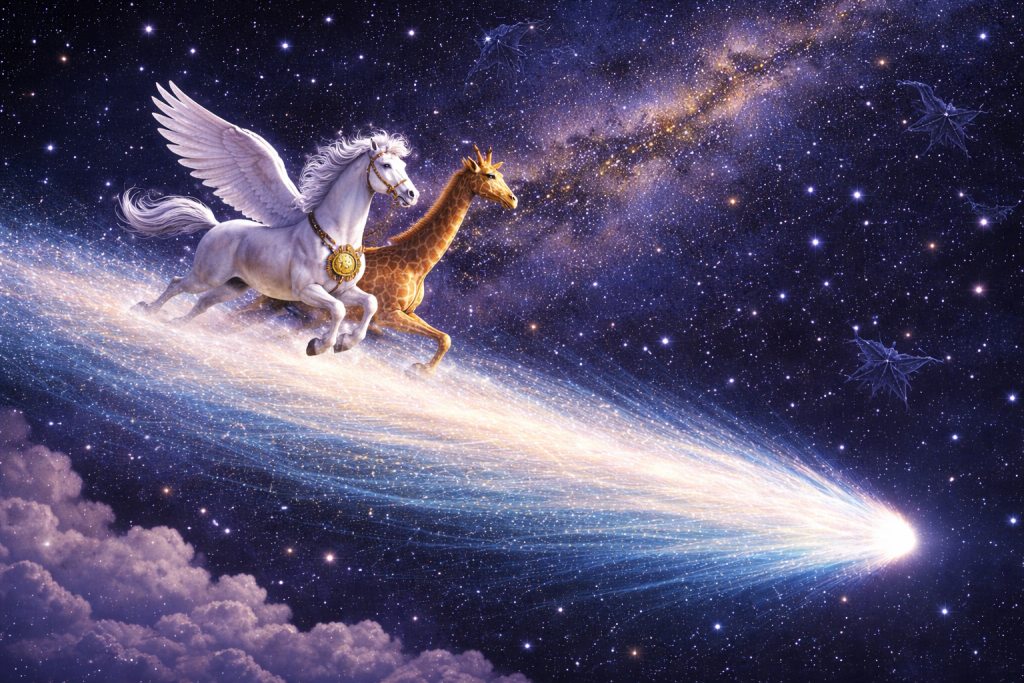
The comet zoomed its way through the zodiac constellations: first Virgo, then Leo, Cancer, Gemini, and, finally, Taurus. The travelers knew these constellations lay on the sun’s path through the sky. They also knew they had to jump off between upcoming Aries and Pisces in order to get home. The stars of Aries and Pisces do not shine brightly and there was risk of missing their home completely if they made a mistake.
Pegasus and Camelopardalis crouched together, ready to disembark as the first stars of Pisces came into view. Their eyes scanned the starscape for Andromeda and Perseus. They jumped. Pegasus beat his wings to slow down. Camelopardalis stretched his long neck, like a hook, around Pegasus’s neck, and remained suspended like ballast until they stopped. They were finally home.
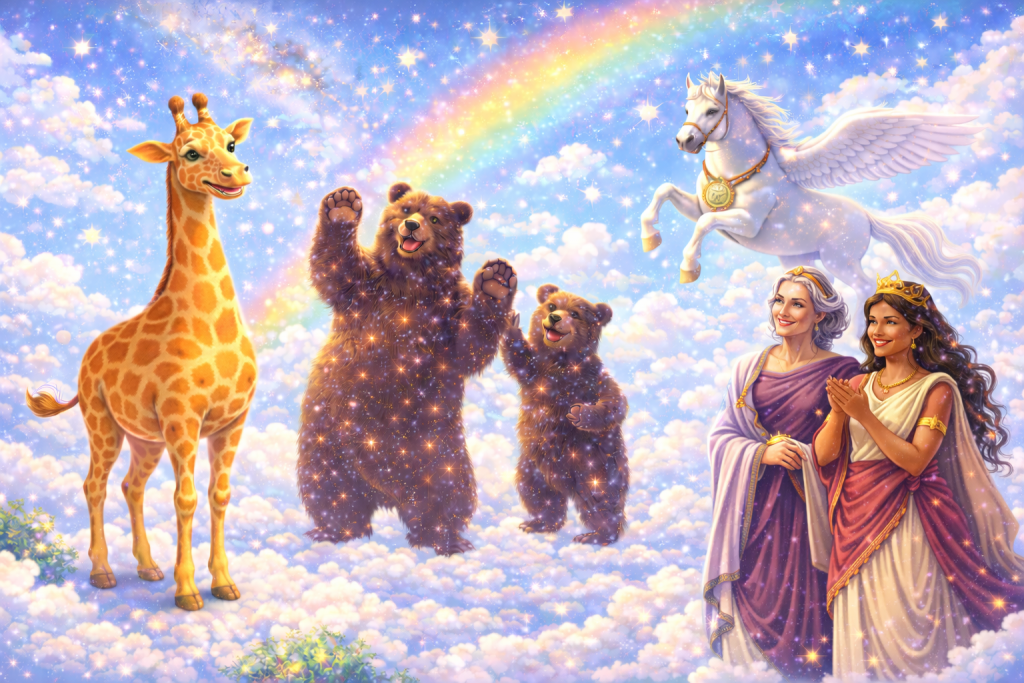
Their arrival brought cheers and bear-paw high-fives from Ursa Major and Ursa Minor, who had looked for their friends’ return every night. Even aloof Cassiopeia and Andromeda seemed relieved. During the coming winter, Pegasus and Camelopardalis would share their adventure of being lost in the Southern sky with the constellations of the North, for whom the South had always been a mystery. The two travelers remembered with fondness their new friends in the South, and wondered if they would all ever meet up again. As they took their positions in the Northern sky, Corvus, whose stellar vista almost spanned both hemispheres, could just make out that Pegasus and Camelopardalis were in the right place, and he proclaimed to the Southern flock:
“The chewing gum sticks to the roof of the hippopotamus.
Slide onto the porch, mates!
All is well!”
© 2025 Dipen Bhattacharya & Lisa Conyers. All rights reserved. First published at dipenb.org
Leave a Reply