Large slope failures are rare, but when rock, ice and debris collapse together in the high Himalayas, the volumes involved can be enormous. I started looking into their history while trying to understand the recent Langtang collapse in Nepal.
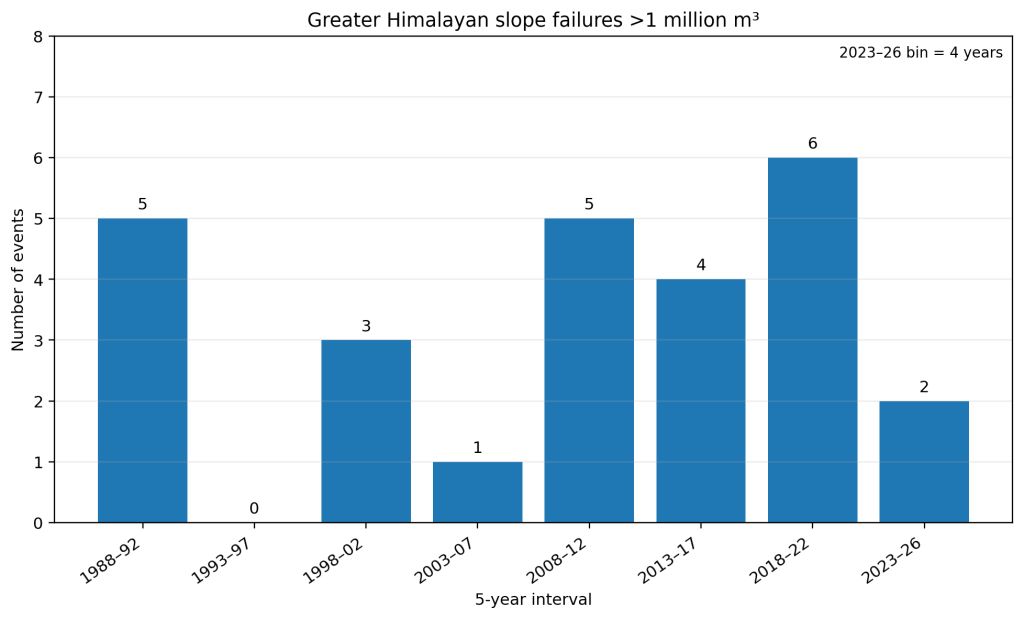
Large slope failures in the Himalayas over the past three decades.
The Langtang collapse
The recent mountainside collapse in Nepal has left lasting and harrowing impressions on us through numerous videos taken by ordinary people who managed to escape the hazard. But there are also a few CCTV images, especially the one at the Gyirong border post, that have created a particular sense of terror. People were washed away before they could realize what was happening. There are now legitimate questions about whether this type of event is going to become more frequent as the Earth warms, whether infrastructure construction in these areas has any effect, or whether this is simply part of the natural pattern—that is, whether the frequency of such calamities has actually remained more or less steady. These are difficult questions to answer, especially because the number of recorded events is small, although each individual event can create enormous havoc.
To investigate this, I tried to gather as many large slope-failure events as I could, both in the Himalayas and in the rest of the world. I excluded flows induced by volcanic eruptions and included only events for which the volume of the initial failed material could be reasonably accounted for. I then divided the events into Himalayan and non-Himalayan groups, with the Karakoram included in the Himalayan region. I also divided them by size: events involving more than 1 million cubic metres and those involving more than 10 million cubic metres. The larger threshold is particularly useful because events of more than 10 million cubic metres are much more difficult to have gone unnoticed. I examined the period from 1988 to 2026; the record of smaller events becomes increasingly incomplete as we go further back in time.
What I found is that there is evidence for an increase of about 6% per year in Himalayan slope failures larger than 10 million cubic metres. The statistical test gives a p-value of about 0.02; in other words, under a model in which there is no underlying increase, the probability of obtaining a trend this strong is about 2%. However, this calculation is based on Poisson statistics and a rather small number of events, so the result has to be treated with caution.
In contrast, I found essentially no upward or downward trend in the rest-of-world database after excluding the Himalayas. But there is an important qualification. When the Himalayan and rest-of-world trends are compared directly, the difference between them is suggestive but does not quite reach the conventional level of statistical significance: the likelihood-ratio test gives a p-value of about 0.079. So the Himalayan increase is intriguing, but with the limited number of events available, I do not think we can yet claim that the Himalayas are behaving statistically differently from the rest of the world.
Science Notebook — full catalogue, sources, calculations and working notes